

The Price No One Can See
One freelance project. One island. And a broken market that works against everyone standing on either side of it.

To do product work well, you have to understand a problem better than the people who handed it to you. That is the part of the job I love most, and now and then it rewards you in a way no one asked for. You go looking for the answer to one question and find a larger one sitting right next to it. That is what happened to me on Mallorca.
I am a freelance product designer. A while ago I took on a narrow, specific brief in Mallorca’s real estate market, the kind of thing you are hired to deliver, and I delivered it. But to do it properly I had to learn how property actually changes hands on the island, who buys it and through whom. The deeper I went, the more one pattern kept surfacing, something the brief never mentioned and that I could not unsee once I had noticed it. When the work was done, I went back and pulled on the thread. This is where it led, and I think it is worth your time whether you build products, invest in them, or have only ever tried to buy a home and wondered why the whole process felt as though it was working against you.
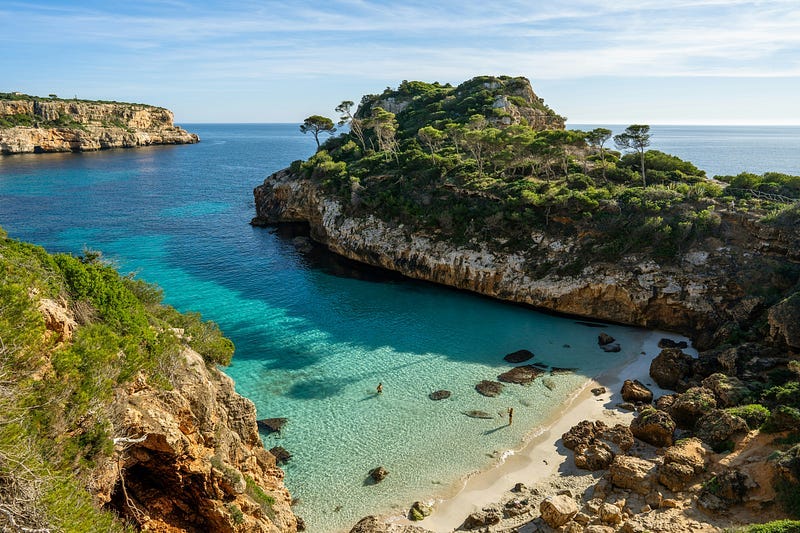
For anyone who has never been, Mallorca is a Mediterranean island off the eastern coast of Spain, all turquoise water and pale limestone hills, and for most of a century it has been one of the places wealthy northern Europeans most want to own a piece of. Hold that picture, because the island turns out to be an almost perfect specimen. Every flaw in the way we buy property is magnified here until it is impossible to miss.
The method is the part of this I most want to pass on. When the pattern first caught my eye, I did not trust it. A hunch from a single project is just a hunch. So, before I let myself get excited, I went to find out whether what I had seen was real or whether I had simply invented it, and I did that by reading, rather than by running interviews or surveys. There is decades of careful academic work on how housing markets behave, and a long public trail of transaction data from Spain and the Balearics. Real estate, it turns out, is one of the most stubbornly inefficient markets in the modern economy and has been studied as such for a long time. Primary research matters but run too early it mostly hands you back your own assumptions wearing a lab coat. The existing work is free to anyone willing to sit with it, and most people rush past it straight to users. I think that is backwards. You earn the right to ask good questions by first learning what is already known. The pattern I had spotted turned out to be one of the best-documented problems in the field.
The numbers alone are striking. The Balearics are the most international property market in Spain by a wide margin. Depending on whose figures you read, foreign buyers have accounted for somewhere between a third and 40% of every home sold there in recent years, against a national average closer to 12%. Spain’s notaries put the 2024 share at about 42%. Many of those buyers are wealthy, often paying entirely in cash, frequently buying from another country without ever moving there. The squeeze on locals is just as measurable: by the notaries’ own affordability index, a family in the Balearics has to stretch far harder to buy a home than the average Spanish household. If the process of buying a home is broken anywhere on earth, this is the place you would expect to notice it first.
The research is strikingly consistent about where it breaks, and it nearly always comes back to one thing. Real estate is the textbook case of what the economist George Akerlof called a market for lemons, a market where one side knows far more than the other. The seller knows what a property is really worth and what is quietly wrong with it. The buyer does not. Almost everything else grows out of that single imbalance. On Mallorca there is no clean public record of what homes have actually sold for, so the market price becomes, in practice, whatever an agent can say with a convincing face. The same villa shows up on five agencies’ sites at three different prices, photographed in three different years, and the buyer is left to untangle the noise by hand. People commit a million euros, often several, to a house they have never stood inside, in a country whose language and law they do not speak, on the word of a stranger whose income depends on the sale closing. To check what actually matters, whether the seller truly owns it and owes nothing hidden against it, whether it was ever built legally, they must navigate a foreign maze of notaries and lawyers from a thousand kilometres away, every step carrying its own fee and delay, the whole thing stretching across most of a year.
Here is the part that stopped me, and the reason I came to think this was worth far more than a note in my files. None of it is only a foreigner’s inconvenience. The same fog that lets a villa sell to a buyer from abroad at an inflated price is the fog that hides true values from a young local family trying to buy a first apartment. When no one can see what anything really costs, speculation thrives in the murk, and prices drift free of what ordinary people earn. On Mallorca this has stopped being abstract. Housing is now openly called the single greatest problem facing the people who live there, prices have badly outrun local wages, and the politics have turned raw, with proposals for steep taxes on foreign buyers and outright purchase bans that European law makes almost impossible to pass. An island is quietly changing hands. The outsider and the local are standing on opposite sides of the very same broken window, one overpaying through it and the other shut out by it, and the cause beneath both is the same: a market that profits from being impossible to see clearly. At bottom it is a question of who gets to belong to a place, and once you put it that way, it becomes very hard to find anyone who thinks the current arrangement is fine.
That was the moment the whole thing finally became a design problem I could hold in one hand. What is broken is not the houses, or even the prices. It is the journey. Buying a home is still assembled out of a dozen disconnected pieces, an agent, a lawyer, a bank, a notary, an endless thread of emails, a flight or two, and the buyer is left holding every loose seam while no one is accountable for the whole. So the question I could not put down was almost insultingly simple. What if the entire journey lived in one place, and was built around the buyer’s clarity instead of the agent’s commission?

The shape of the answer, and I would insist on calling it a hypothesis rather than a plan, is a single platform that carries a buyer from the first search all the way to the keys in their hand, with verification and honesty built into every step rather than bolted on at the end. One clean, de-duplicated source of real listings and real sold prices, so the question every buyer is secretly afraid of, am I overpaying, finally has an honest answer. Distance handled with verified video and on-demand viewings, so a thousand kilometres stops being a wall. Ownership and debts and permits and condition all checked inside the platform by independent professionals, not by the seller’s hand-picked ones. The money, the single most frightening part, moved through protected escrow instead of wired off into the dark. And the close, the final signing and the handover of the keys, finished without the buyer ever once losing the thread. None of the pieces are exotic. The whole, built for this particular buyer, is what does not yet exist.
Which raises the obvious and slightly deflating question. If the gap is this clear, why has no one filled it? So I went looking for whoever might already be building it. The honest answer is that the pieces exist almost everywhere and the whole exists almost nowhere. There is serious, well-funded property technology in this part of the world. Clikalia in Spain, and the Italian company Casavo, which also operates there, have raised enormous sums on the iBuyer model, in which the company itself buys your home, sometimes within days, fixes it up, and sells it on. It is impressive, and it solves a different problem for a different person, the seller who wants a fast, certain exit, and it works because it can put an algorithmic price on a standard city flat and flip it. You cannot price-and-flip a one-off villa with a sea view that way, and it does nothing for the remote buyer’s journey. The American story is even more telling. Opendoor still runs the iBuyer model, but the two giants who tried it alongside them, Zillow and Redfin, both shut their home-buying arms down, in 2021 and 2022, after losing a fortune. The model that was supposed to swallow the market quietly retreated from it. Around the edges, commission-free agencies trim the fees and the big portals own the search and then hand you off. Everyone owns a slice. No one has stitched the buyer’s whole journey, from the first search to the final handover, into one trusted flow built specifically for high-value, cross-border property. That corner, where the pain runs deepest and the buyer is most often a stranger from abroad, is the one almost everyone has left alone, because it is hard and bespoke, and refuses to fit a clean flippable model. The industry can feel the direction of travel, and analysts have started calling transactional transparency the defining shift of the coming decade. But sensing a direction and actually serving this buyer are two very different things.
It is worth taking seriously, because filling that gap would help far more than the wealthy outsider it first appears to flatter. A market you can see through is safer for the foreign buyer and fairer for the local family that can finally tell a real price from a flattering one. It is also far more hostile to the speculation that feeds on confusion. Legibility does not fix everything. Prices are partly a problem of supply, and no platform builds houses. But a market that is easy to see is one that is far easier to keep honest. Solve the journey and you do more than sell villas. You make the market legible, which is the thing fairness has to stand on.
So, would it work? I do not know yet, and that is the right place for an idea this young to sit. This is where the reading runs out and the real test begins. It has to face the people it claims to help, the buyer who flew in for a viewing that looked nothing like the photographs, the local family watching their hometown drift out of reach, and the people it might threaten, the agents who may not want any of it. Then I watch for where it holds and where it breaks.
If there is a lesson in any of this, it is plainer than I would like. The brief you are handed usually sits on top of a larger system that is creating the problem, and the work only gets interesting when you go looking for that system, even though no one hired you to. So go deep enough to understand a problem better than the people who handed it to you, and trust the pattern that keeps surfacing, as long as you test it against what is already known before you let yourself fall for it.
And there is a harder lesson sitting underneath the first one. Notice which problems tend to survive the longest. The ones that last are usually the ones that pay someone to keep them out of sight. Mallorca is an extreme case, beautiful enough that the damage is easy to look past, but the shape of it is everywhere. Any market or institution that profits from being hard to see is quietly moving something from the people who cannot see it to the people who can. The real work, more often than not, is the slow and unglamorous business of making one of those things visible. Mallorca handed me one. What stays with me is how rare it turns out to be, the plain act of looking clearly at something everyone has quietly agreed to stop seeing.