

The Other Side of the Leap
On trust between founders and the people they hire, and the quiet reason some working relationships refuse to end on schedule.


Freelance work is supposed to be short. You arrive, you deliver a defined thing, you invoice, you move on. That is the shape of the trade, and most people I know live comfortably inside it. Mine keeps refusing to follow the script. A project that begins as a few screens for an early prototype stretches into the MVP, then survives into the investment round, then into the pitch itself, and somewhere along the way both sides quietly stop pretending it was ever a short engagement. I have been trying to understand why for a long time, partly out of gratitude and partly out of curiosity, and what follows is the closest I have come to an answer.
The founders I have worked with are not alike. Some understand their own product down to the smallest decision. Others, especially earlier in my career, could see what they wanted to build with complete clarity but had no way of judging the design or the development or the management underneath it, because those were never their languages. What they share is a position I did not properly appreciate for years, because I was too busy worrying about my own side of the table. Every one of them was spending serious money, often money that took years to gather, on people whose work they could not fully evaluate. I try sometimes to actually sit in that chair. You are sending a large sum to someone you barely know, for something you cannot inspect until it is too late to change your mind, and the person you are paying is the only one in the room who knows whether the plan is sound. We talk about founders and risk in an admiring, abstract way. Up close, a good part of the risk is simply the people they hire. People like me.
For most of my early career I assumed the answer to all of this was good work. Do the work well, and trust accumulates on its own, a small deposit with every solid deliverable. The longer I have sat with it, the less I believe that, and the reason took me a while to accept. Good work is the baseline. It is what everyone was hired for, and more to the point, it is what a purely self-interested person would also produce, because hitting the deadline and polishing the screens is exactly what keeps the money coming. When my interests and a client’s point in the same direction, my behaving well tells them almost nothing about me. They learn that I am competent. They cannot learn what I would do on the day our interests split, and that day is the only one they are actually afraid of.
So, trust, if I follow the thought honestly, can only be built in a narrow and strange set of moments: the ones where you could profit from someone and choose not to. Everything else is pleasant noise. There is a well-known idea in economics, from Michael Spence, that points at the same thing from another angle. He called it signaling, and the core of it fits in one line: a message is only believable when it costs the sender something. Words are cheap, which is why anyone can claim to be honest and why the claim carries no information at all. A signal that hurts to send is different. It cannot be faked cheaply, so it is the only kind that gets believed. Once the shape of that idea settles in, you start to recognize what the believable signals in this trade actually are. The feature you argue against, knowing you would have been the one paid to build it. The estimate you revise downward because the work turned out simpler than you priced. The mistake you raise before anyone would have found it. The month you tell someone not to hire you, because they are not ready to use you well. Each one is an invoice that never existed, and each one is expensive in the moment, which is precisely why it means something. None of them feel strategic when they happen. Mostly they feel like small acts of self-harm, and I suspect that feeling is the point. If it cost nothing, it would say nothing.
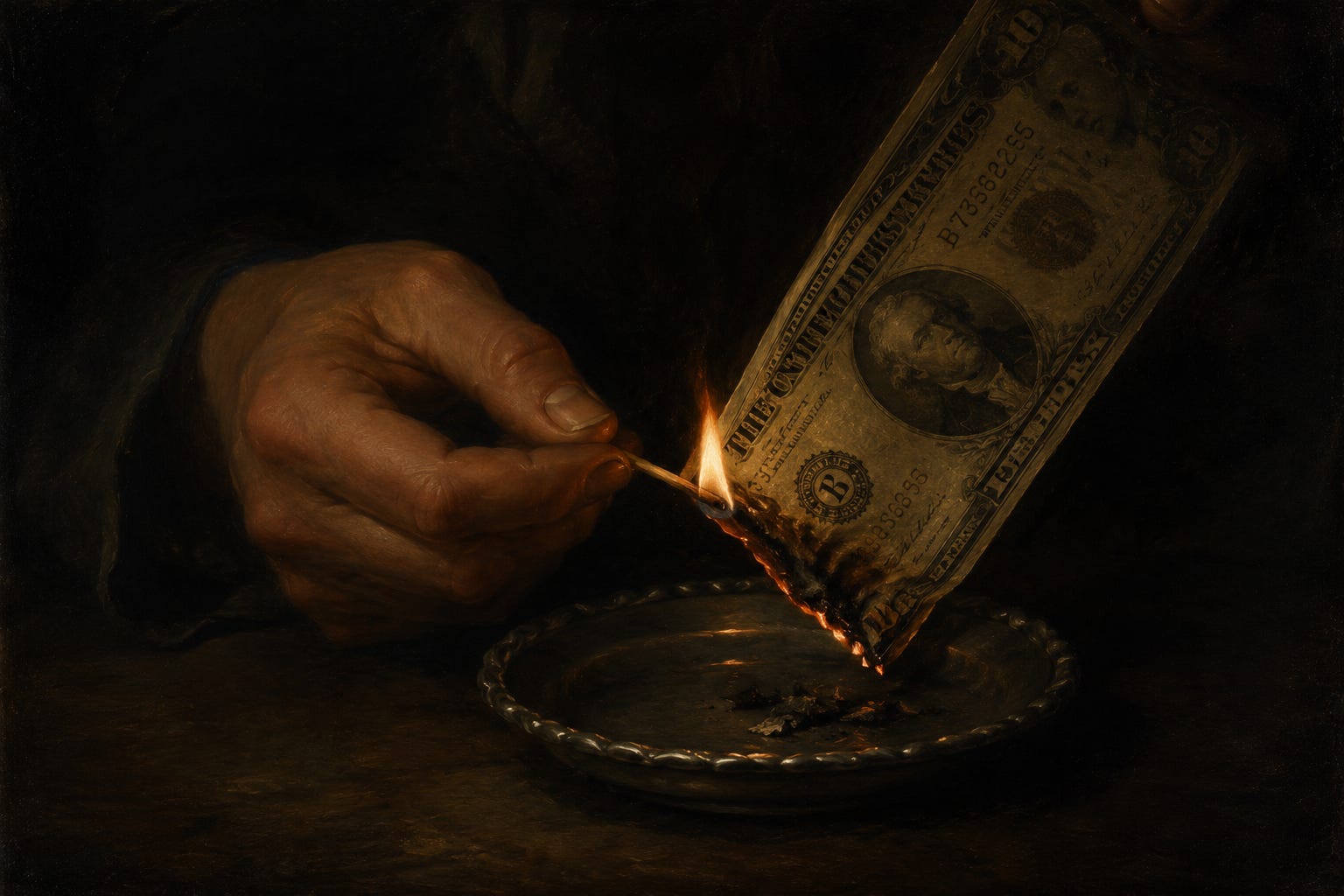
What does the founder actually receive in those moments? For a long time, I would have said better decisions, and sometimes that is true. But the deeper thing is quieter. A founder carries the company around in their head all day, and a real part of that weight is vigilance, the low, constant work of wondering whether the people they pay are telling them the whole truth. That worry appears in no budget and gets admitted to almost no one. The first time someone demonstrates, at their own expense, that they will volunteer the inconvenient truth unprompted, a founder gets to put that vigilance down, at least in one direction. They stop composing the checking-up email in their head. What they were buying was never really the screens. It was the ability to stop thinking about the screens. I keep returning to that as the most honest description of a long engagement I can manage, one person taking custody of a corner of another person’s worry. There is something almost tender in it, though I would phrase it more carefully in a meeting.
Follow that thought one step further and it opens onto something much larger, which I did not expect when I started pulling on it. All that vigilance has a cost, and the cost does not stop at one worried founder. Every relationship, every company, every country pays a hidden tax that is proportional to how little it’s people can trust each other. The tax is called checking. Contracts thick enough to survive a betrayal, approvals stacked on approvals, receipts for the receipts, the meeting held to confirm what the last meeting decided. None of that produces anything. All of it exists because somebody, somewhere, might not be straight, and so everyone must be treated as if they might not be. A team whose members never have to verify one another moves at a speed that looks, from the outside, like talent. Often it is nothing of the sort. It is simply that doubt has been removed, and with it the enormous invisible cost of re-checking everything twice. I have slowly come to believe that most of what we call efficiency is trust wearing work clothes, and that the most expensive thing in any system, a marriage, a startup, a state, is doubt. Which changes what a trustworthy person actually is. They are a subsidy. Every hour their colleagues do not spend double-checking them is an hour their honesty quietly paid for, and almost nobody sends them the bill they covered.
This also settled, for me, a question about portfolios I had carried for years without quite being able to phrase. A portfolio matters, and I tell every beginner to build one, because it is how a stranger checks that you can do the work at all. But it can only ever carry half of you. Competence leaves artifacts. Screens, systems, shipped things, all of it can be photographed and uploaded and browsed by someone who has never met you. Character produces no artifact. There is no file format for the feature you argued against, no case study for the fee you gave back. Character leaves only witnesses. Which explains something I had noticed but could not account for: somewhere in the middle of a career, the portfolio quietly stops being what brings the work in, and the stories people talk about you take over, told in rooms you are not in, by people describing a moment when you could have taken more from them and didn’t. So, the most important asset of a working life ends up stored outside you, scattered across other people’s memories, where you can neither audit it nor spend it directly. You cannot even see your own. You only ever make deposits, one expensive sentence at a time, and it circulates entirely without you.

I want to name the trap in all of this rather than pretend the thinking is tidy. The moment costly honesty becomes a tactic, a calculated deposit toward future contracts, something in it spoils. People detect performed virtue far better than we like to admit, and honesty-as-strategy has a smell that honesty-as-habit does not. Which leaves a slightly circular truth sitting in the middle of the whole subject, and I have not found a way around it: the signals only work when they are not sent in order to work. I should also say plainly that the world does not always cooperate. Costs get eaten that nobody notices. There are rooms that reward the confident liar over the careful truth-teller, and no amount of integrity fixes a room like that. Being worth trusting is not a machine you put coins into.
So, I do not end at a formula, and I have grown wary of anyone whose thoughts on trust arrive at one. What I am left with is smaller, and it has held up. The projects that would not end on schedule were never extended because a deliverable impressed someone. Somewhere inside each of them there must have been a moment, probably unannounced, probably invisible to me as well, when a founder stopped checking behind me, and everything that followed flowed out of that. The work I can point at afterwards is the visible part. The part that decided everything else has no artifact at all, and I have made my peace with that. No one will ever browse it. It exists for one person at a time; on the day they are deciding whether they can stop worrying about you.